
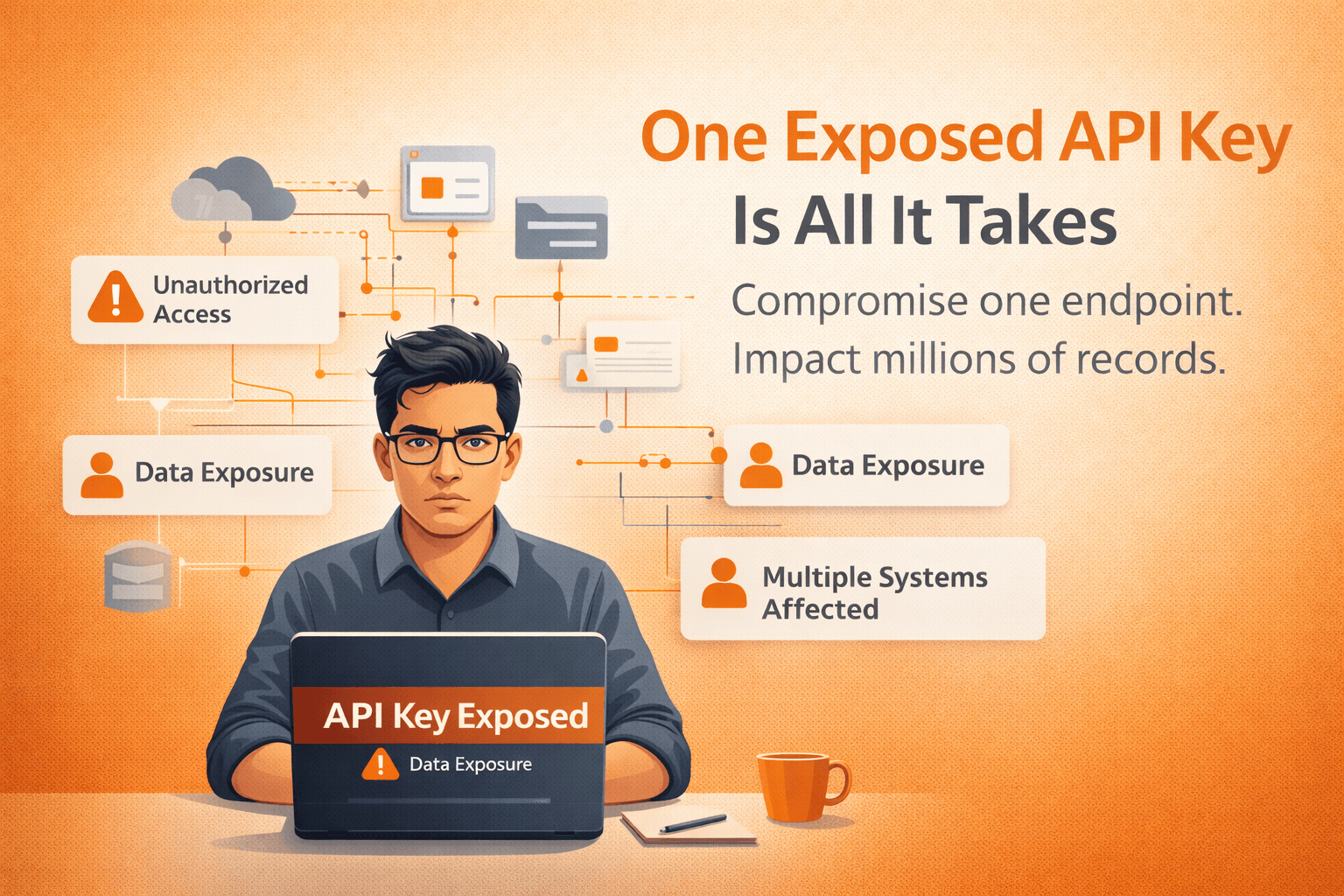
Not a zero-day exploit. Not an advanced persistent threat. Just a single, exposed API.
In today’s API-driven economy, that’s often all an attacker needs.
APIs – Application Programming Interfaces – are the invisible backbone of modern business. They power your payment gateway, your mobile app, your CRM integrations, your cloud infrastructure. Every time your app talks to another system, an API is doing the work.
And that’s exactly the problem.
As digital transformation accelerates, the number of APIs in a typical enterprise has exploded. According to Salt Security’s 2024 State of API Security Report, the number of APIs increased by 167% in a single year – and 95% of organizations experienced security problems in their production APIs.
We’ve expanded the attack surface faster than we’ve learned to secure it.
What Exactly Is API Leakage?
API leakage happens when sensitive API credentials, tokens, or endpoints are exposed — intentionally or not – to unauthorized parties. It’s not always a dramatic hack. Sometimes, it’s devastatingly mundane:
- A developer hardcodes an API key directly into source code
- That code gets pushed to a public GitHub repository
- An attacker running an automated scanner picks it up within minutes
- Game over
Other common forms include:
- Exposed endpoints – APIs that are live but forgotten, with no authentication required
- Misconfigured access controls – APIs that return more data than they should
- Leaked tokens in CI/CD pipelines – credentials embedded in build scripts
- Shadow APIs – undocumented endpoints that nobody’s monitoring
These exposures are actively hunted by attackers using automation tools. Real-World Incidents: When APIs Become Entry Points
GitHub Secrets Spill -2024
In March 2024, a breach exposed nearly 13 million API secrets through public GitHub repositories, leaving companies vulnerable as attackers exploited these credentials to gain unauthorized access. Thirteen million. From code that was never meant to be public — but was.
Dell – 49 Million Records (May 2024)
Dell experienced a breach affecting 49 million customer records due to an API vulnerability, where attackers exploited a partner portal API through fake accounts. A partner-facing API, meant to enable business – weaponized to steal at scale.
Instagram API Scraping – January 2026
In January 2026, a dataset containing 17.5 million Instagram user records appeared on BreachForums – a dark web marketplace. The data included full names, email addresses, phone numbers, and partial location data. The breach exploited a 2024 API vulnerability with inadequate rate limiting.
Meta’s response? They called it “scraping,” not a breach.
But here’s the truth: when your information is on the dark web, the distinction between “breach” and “API scraping” is meaningless. The damage is identical.
DOGE Developer — xAI API Key on GitHub (July 2025)
On July 13, 2025, a private API key for xAI’s language models was accidentally published on GitHub by a developer at Elon Musk’s Department of Government Efficiency (DOGE). Even the organizations building the future of AI aren’t immune to a single developer’s mistake.
How the Attack Actually Happens
Step 1 – The Exposure A developer, working under deadline pressure, hardcodes an API key or commits credentials to a repository.
Step 2 – The Discovery Automated bots constantly scan GitHub, GitLab, and public endpoints for exposed credentials. Tools like TruffleHog and GitGuardian do this – and so do attackers. The window between exposure and discovery is often under 60 seconds.
Step 3 – The Access The attacker uses the key to authenticate as a legitimate user. No brute force. No malware. Just a valid credential – obtained for free.
Step 4 – The Damage Data is exfiltrated. Cloud resources are abused. Ransomware is deployed. Or the credentials are sold on the dark web to the highest bidder
Business Impact: Beyond the Technical Damage
API leakage is not just a security issue – it’s a business risk multiplier.
Financial Impact
- Breach remediation costs
- Legal settlements and fines
- Incident response and downtime
Regulatory Consequences
- GDPR and data protection penalties
- Compliance failures (ISO, SOC2, etc.)
Brand & Reputation Damage
- Loss of customer trust
- Negative media exposure
- Long-term brand erosion
Customer Impact
- Account takeovers
- Data privacy violations
- Increased churn
Operational Disruption
- Service outages
- Internal system compromise
In many cases, the reputational damage far outweighs the immediate financial loss
Why Is This Getting Worse, Not Better?
1. The DevOps Speed Trap Modern development moves fast. CI/CD pipelines deploy code in hours. Security reviews happen after – or not at all. Secrets leak because speed is rewarded and caution isn’t.
2. The Shadow API Problem Many APIs don’t appear in security scans. Some are deployed quickly, tested loosely, and forgotten entirely. But for attackers, they’re ideal entry points.
3. AI Is Changing the Attacker’s Game Attackers can now utilize AI bots to learn from API responses in real-time, rapidly identifying misconfigurations and exposed endpoints. The reconnaissance that once took days now takes minutes.
Despite growing API traffic, only 7.5% of organizations have implemented dedicated API testing and threat modeling programs.
Prevention: What Mature Organizations Are Doing Differently
API security requires a shift from reactive to proactive defense.
Secure Secret Management
Never hardcode API keys
- Use tools like Vault or cloud-native secret managers
Strong Authentication & Authorization
- Implement OAuth, JWT, and role-based access control
- Enforce least privilege access
Continuous Security Testing
- Regular penetration testing
- API-specific vulnerability assessments
API Monitoring & Threat Detection
- Track abnormal API behavior
- Detect unusual traffic patterns
API Inventory & Governance
- Maintain a centralized API inventory
- Identify and eliminate shadow APIs
Security Awareness & Developer Training
s are the new perimeter – but most organizations are still protecting them with outdated security models. Firewalls and endpoint security are no longer enough.
If your APIs are exposed, your core business logic and data are exposed.
APIs are enabling innovation at an unprecedented scale. But they are also quietly becoming the most exploited attack vector in cybersecurity.
The risk is not hypothetical. The incidents are not rare. And the impact is not small.