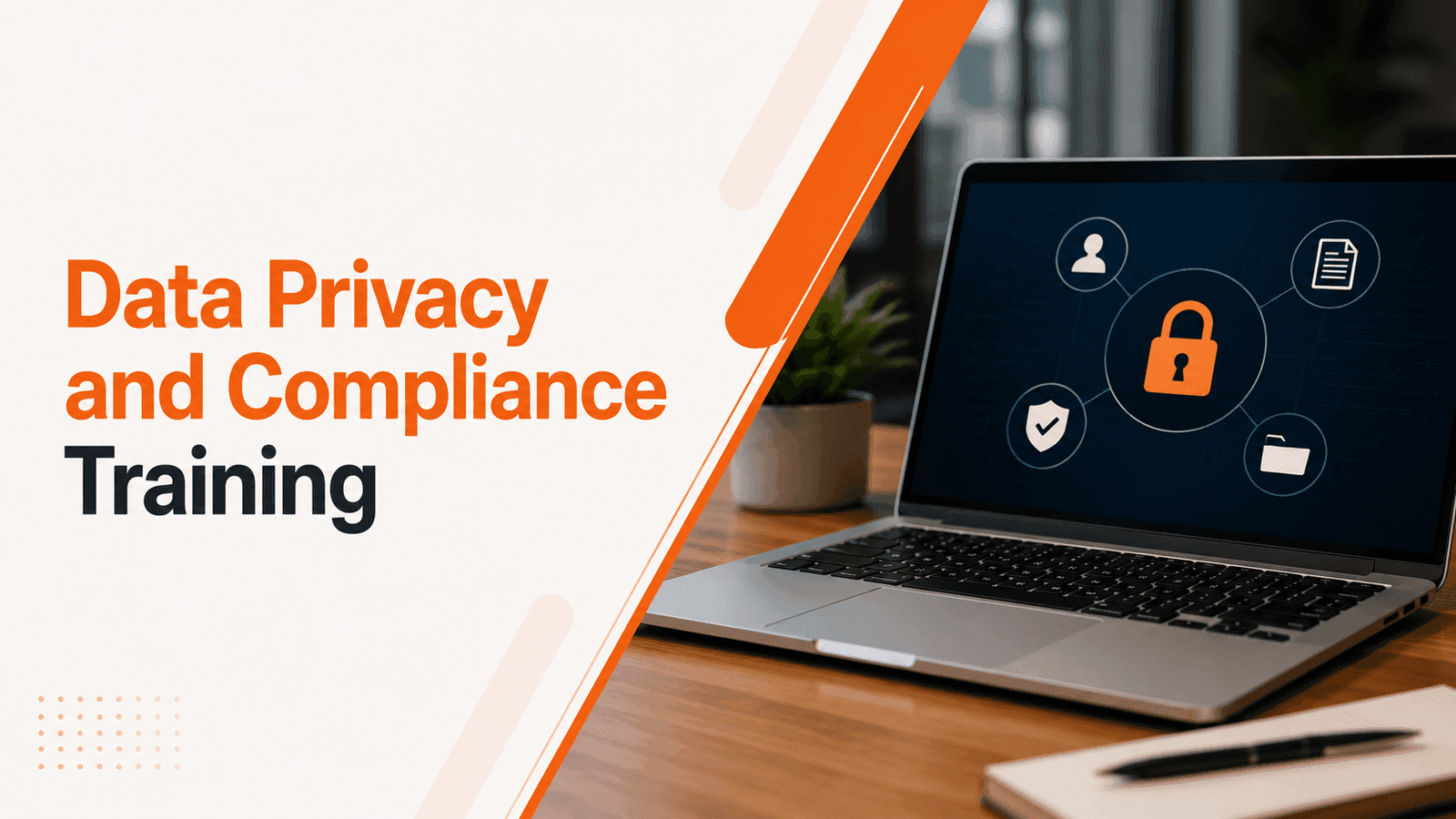
Data Privacy and Compliance Training

Data Privacy and Compliance Training

Team Innvikta

Team Innvikta

Published: 30 Jun 2026 • 05 Mins read

Data Privacy and Compliance Training: Building a Culture of Trust and Accountability

Data privacy and compliance training educates employees on how to collect, process, store, share, and protect sensitive information while complying with applicable privacy regulations and organizational policies. It helps reduce human error, strengthens cybersecurity, supports regulatory compliance, and builds a culture where protecting personal and business data becomes part of everyday work.

Key Takeaways

  1. Data privacy is everyone's responsibility—not just the IT or legal team.

  2. Employee mistakes remain one of the leading causes of data breaches.

  3. Privacy and compliance training helps employees understand how to handle sensitive information securely.

  4. Continuous awareness is more effective than annual compliance sessions.

  5. Organizations should combine privacy education with phishing simulations and role-based learning.

  6. A strong compliance culture improves customer trust and reduces organizational risk.

What Is Data Privacy and Compliance Training?

Organizations collect and process enormous amounts of personal and business information every day. Customer records, employee files, financial information, healthcare data, contracts, and confidential business documents all require careful handling.

Data privacy and compliance training teaches employees how to manage this information responsibly while following organizational policies and applicable legal requirements.

Rather than focusing only on regulations, effective training explains why privacy matters, how cyber threats exploit human behavior, and what employees should do to protect sensitive information during their daily work.

An effective training program covers both privacy responsibilities and practical cybersecurity habits, ensuring employees understand how their decisions affect the organization's overall security posture.

Why Employee Training Matters

Many organizations invest heavily in cybersecurity technologies such as firewalls, endpoint protection, encryption, and identity management. However, even the strongest technical controls cannot prevent mistakes made by employees.

Examples include:

  • Sending confidential files to the wrong recipient.

  • Clicking phishing links.

  • Sharing customer information without verification.

  • Using weak passwords.

  • Uploading sensitive files to unauthorized cloud storage.

  • Discussing confidential information in public places.

  • Leaving printed documents unattended.

Most of these incidents are preventable through continuous awareness and practical education.

Employees who understand privacy principles are more likely to make informed decisions when handling sensitive information.

HUMAN RISK MANAGEMENT

See Innvikta InSAT in Action

Explore how our interactive games, realistic phishing simulations, and gamified training modules dramatically reduce organizational human cyber risk.

© INNVIKTA SECURITY
YOUR DETAILS

Common Data Privacy Risks in the Workplace

Data privacy incidents are often caused by everyday workplace activities rather than sophisticated cyberattacks.

Human Error

Simple mistakes such as attaching the wrong document to an email or selecting the wrong recipient can expose confidential information.

Phishing Attacks

Cybercriminals frequently use phishing emails, SMS messages, and messaging platforms to steal employee credentials or gain access to sensitive systems.

Without awareness training, employees may unknowingly disclose confidential information.

Weak Password Practices

Using predictable or reused passwords makes organizational systems easier to compromise.

Employees should understand password security and enable multi-factor authentication wherever possible.

Unauthorized Data Sharing

Sensitive information should only be shared with authorized individuals using approved communication channels.

Employees should verify requests before sharing customer records, financial information, or internal documents.

Lost Devices

Laptops, smartphones, and USB drives containing sensitive information can expose organizations to significant risks if lost or stolen.

Employees should understand secure device management and reporting procedures.

Shadow IT

Employees sometimes use personal cloud storage, messaging applications, or productivity tools without organizational approval.

These unauthorized applications may lack adequate security controls and increase compliance risks.

Regulations That Emphasize Employee Awareness

Many privacy and cybersecurity regulations expect organizations to implement organizational measures that include employee education and awareness.

Examples include:

Digital Personal Data Protection Act (DPDPA)

Organizations handling digital personal data should establish appropriate safeguards and promote responsible data handling practices.

GDPR (General Data Protection Regulation)

Organizations processing personal data should ensure employees understand privacy responsibilities and data protection principles.

ISO/IEC 27001

Information security awareness and competence are important elements of an effective Information Security Management System (ISMS).

HIPAA

Healthcare organizations must educate workforce members on safeguarding protected health information (PHI).

PCI DSS

Organizations handling payment card information should train employees on secure handling practices and fraud prevention.

Although regulatory requirements differ, they all recognize that employee awareness contributes to stronger data protection.

Essential Topics Every Privacy Training Program Should Cover

A modern awareness program should include practical scenarios employees encounter every day.

Understanding Personal Data

Employees should know what qualifies as personal information and why it requires protection.

Examples include:

  • Customer names

  • Email addresses

  • Phone numbers

  • Financial records

  • Employee information

  • Health data

  • Government-issued identifiers

Data Classification

Training should explain how organizations classify information and the appropriate handling requirements for each category.

Secure Data Handling

Employees should understand how to:

  • Collect information responsibly.

  • Store data securely.

  • Transfer files safely.

  • Dispose of sensitive information appropriately.

Password and Authentication Security

Strong passwords and multi-factor authentication reduce the likelihood of unauthorized access.

Phishing Awareness

Employees should recognize phishing emails, SMS messages, QR-code phishing (Quishing), business email compromise, and social engineering attacks.

Remote Work Security

Hybrid employees should understand secure Wi-Fi usage, VPNs, mobile security, clean desk practices, and secure document handling outside the office.

Incident Reporting

Employees should know:

  • What constitutes a security incident.

  • Who should be notified.

  • How quickly incidents should be reported.

  • Why early reporting is critical.

Benefits of Continuous Privacy and Compliance Training

Organizations that invest in ongoing awareness programs experience long-term benefits.

Reduced Human Error

Employees become more confident identifying risky situations before they lead to data breaches.

Stronger Security Culture

Privacy becomes part of everyday decision-making rather than a compliance exercise.

Improved Regulatory Readiness

Organizations can demonstrate ongoing employee education and awareness initiatives during audits and assessments.

Better Customer Trust

Customers are more likely to trust organizations that prioritize responsible data handling and employee education.

Lower Business Risk

Reducing human-related incidents minimizes operational disruption, financial losses, and reputational damage.

Best Practices for Privacy and Compliance Training

Organizations should:

  • Provide role-based learning tailored to different departments.

  • Include privacy awareness during employee onboarding.

  • Deliver regular microlearning throughout the year.

  • Conduct phishing simulations and social engineering exercises.

  • Update training to address emerging threats.

  • Measure employee participation and awareness improvements.

  • Encourage employees to ask questions and report incidents without fear of blame.

Awareness should be treated as an ongoing business process rather than a once-a-year requirement.

How Innvikta Supports Data Privacy and Compliance Training

Protecting sensitive information requires more than policies—it requires employees who understand how to apply those policies in real-world situations.

Innvikta's Security Awareness Platform helps organizations strengthen their privacy and compliance programs through engaging, measurable, and role-based learning experiences.

Privacy Awareness Training

Interactive modules covering:

  • Data privacy fundamentals

  • Secure data handling

  • Information classification

  • Privacy regulations

  • Password security

  • Remote work security

AI-Powered Phishing Simulations

Employees experience realistic phishing attacks that reinforce secure handling of sensitive information and improve reporting behavior.

Human Risk Intelligence

Behavioral analytics identify employees requiring additional coaching and provide measurable insights into organizational risk.

Compliance-Focused Learning Paths

Organizations can assign role-specific learning journeys for HR, Finance, IT, Customer Support, Healthcare, Legal, and other business functions.

Executive Reporting

Comprehensive dashboards help leaders monitor:

  • Training completion

  • Employee engagement

  • Phishing performance

  • Human risk scores

  • Awareness trends

This visibility enables organizations to continuously improve their compliance posture.

Conclusion

Data privacy is no longer solely the responsibility of compliance teams or cybersecurity professionals. Every employee who handles sensitive information contributes to protecting customer trust, organizational reputation, and business continuity.

Continuous privacy and compliance training equips employees with the knowledge to recognize threats, follow secure practices, and make informed decisions when handling personal and business data.

By combining practical awareness training, phishing simulations, and measurable behavioral insights, organizations can reduce human-related risks while building a lasting culture of security and accountability.

With Innvikta's Security Awareness Platform, businesses can transform compliance training from a mandatory exercise into a meaningful program that strengthens both cybersecurity and organizational resilience.

Frequently Asked Questions

Data privacy and compliance training educates employees on how to handle personal and sensitive information securely while following organizational policies and applicable legal or regulatory requirements.

Employees frequently interact with sensitive information. Proper training reduces human error, improves awareness, and helps prevent accidental data breaches.

Organizations should provide continuous awareness throughout the year using onboarding sessions, microlearning, phishing simulations, and periodic refresher courses.

Every employee who handles organizational or personal data should receive training. Role-based modules can provide additional guidance for departments such as HR, Finance, IT, Legal, Customer Support, and Healthcare.

Innvikta provides interactive awareness training, AI-powered phishing simulations, Human Risk Intelligence, compliance-focused learning paths, and executive reporting to help organizations strengthen their privacy culture and reduce human-related risks.

Related Articles

AI-Powered Phishing Simulations

AI-Powered Phishing Simulations

AI-Powered Phishing Simulations: Preparing Employees for Modern Phishing Attacks Phishing attacks are becoming more personalized, convincing, and difficult to detect—especially with the use of artificial intelligence. AI-powered phishing simulations help organizations safely test employee readiness using realistic attack scenarios, identify human risk, and deliver targeted security awareness training based on actual behavior rather than assumptions. 1. AI has made phishing attacks faster, more convincing, and highly personalized. 2. Traditional phishing simulations often fail to reflect today's threat landscape. 3. AI-powered simulations generate realistic campaigns based on current attack techniques. 4. Organizations can identify high-risk users and departments using behavioral analytics. 5. Personalized learning improves employee resilience over time. 6. Continuous phishing simulations are a core component of Human Risk Management. Phishing Has Changed—Has Your Security Awareness Program? Phishing has evolved dramatically over the past few years. Attackers no longer rely on poorly written emails filled with spelling mistakes and suspicious links. Today's phishing campaigns are crafted using artificial intelligence, public information, breached data, and social engineering techniques to imitate trusted individuals, brands, and business processes. Modern phishing attacks may impersonate: - Company executives - HR departments - IT support teams - Banks and financial institutions - Microsoft 365 or Google Workspace - Courier services - Vendors and suppliers - Government agencies Employees are no longer targeted with generic emails—they receive highly personalized messages designed to appear legitimate. To prepare employees for these threats, organizations need simulations that reflect the attacks they are likely to encounter in the real world. Why Traditional Phishing Simulations Fall Short Many organizations still rely on static phishing templates that rarely change. While these campaigns provide basic awareness, they often fail to mirror modern phishing techniques. Common limitations include: - Repetitive email templates - Predictable campaign timing - Generic landing pages - Limited personalization - Lack of role-specific scenarios - Minimal behavioral insights Employees eventually learn to recognize the training rather than the attack, reducing the effectiveness of simulations. As phishing tactics evolve, awareness programs must evolve with them. What Are AI-Powered Phishing Simulations? AI-powered phishing simulations use artificial intelligence to create realistic phishing campaigns that adapt to current threats and organizational needs. Instead of sending the same phishing email to every employee, AI can generate campaigns tailored to: - Employee roles - Departments - Industries - Current phishing trends - Attack techniques - Organizational policies - Learning objectives The goal is to safely assess employee readiness while reinforcing secure behaviors through practical experience. How AI Makes Phishing Simulations More Effective Dynamic Email Generation AI creates realistic phishing emails that resemble modern attacks, including: - Executive impersonation - Invoice fraud - HR announcements - IT password reset requests - Vendor communications - Cloud document sharing invitations - Event registrations This variety keeps simulations relevant and prevents employees from recognizing patterns. Personalized Campaigns A finance team faces different threats than HR or software developers. AI enables organizations to tailor phishing scenarios to each department, increasing the relevance and educational value of every campaign. Examples include: - Finance: Fake payment requests and invoice fraud. - HR: Recruitment scams and payroll updates. - IT: Password reset and software update notifications. - Sales: Customer document sharing requests. - Executives: Business Email Compromise (BEC) scenarios. AI-Generated Landing Pages Modern phishing attacks often include convincing login portals. AI-powered simulation platforms can create realistic landing pages that safely demonstrate how attackers attempt to steal credentials. Employees learn to identify warning signs before entering sensitive information. Adaptive Learning Recommendations Instead of assigning the same training to everyone, AI recommends learning modules based on employee performance. For example: - Employees who click phishing links receive additional phishing awareness training. - Users who repeatedly struggle with QR code scams receive focused Quishing modules. - High-performing employees receive advanced cybersecurity challenges. This personalized approach improves engagement while reducing unnecessary training. Human Risk Intelligence AI analyzes employee behavior across multiple campaigns to identify patterns and trends. Security teams gain insights into: - High-risk users - Department-level vulnerabilities - Phishing click rates - Credential submission attempts - Reporting behavior - Training effectiveness These insights help organizations focus resources where they are needed most. Benefits for CISOs and Security Teams Measure Real Human Risk Instead of relying on course completion rates, AI-powered simulations provide measurable evidence of employee behavior. Reduce Successful Phishing Attempts Repeated exposure to realistic phishing campaigns helps employees recognize suspicious messages before they become security incidents. Improve Incident Reporting Employees become more comfortable reporting suspicious emails, strengthening the organization's detection capabilities. Support Compliance Initiatives Many regulatory and security frameworks emphasize employee awareness as part of a comprehensive cybersecurity program. Phishing simulations help organizations demonstrate continuous security education and ongoing risk reduction. Executive Reporting Behavioral analytics enable CISOs to present meaningful security metrics to executive leadership and board members. Best Practices for AI-Powered Phishing Simulations Run Campaigns Throughout the Year Continuous testing reflects real-world conditions better than annual awareness exercises. Simulate Current Threats Update campaigns to include: - AI-generated phishing emails - QR code phishing (Quishing) - Smishing - WhatsApp phishing - Business Email Compromise - Cloud collaboration scams Focus on Learning, Not Punishment The objective is to educate employees rather than embarrass them. Provide immediate feedback and practical learning after each simulation. Personalize Training Different departments face different risks. Tailor simulations accordingly. Measure Improvement Over Time Track: - Click rates - Credential submission rates - Reporting rates - Repeat-risk users - Human Risk Scores Behavioral improvement is a better indicator of success than training completion alone. How Innvikta Delivers AI-Powered Phishing Simulations Innvikta's AI-powered phishing simulation platform is built to help organizations stay ahead of evolving phishing threats while reducing human cyber risk. AI Campaign Generator Create realistic phishing campaigns in minutes using AI-assisted content generation tailored to different industries, departments, and attack scenarios. Dynamic Landing & Login Page Generator Generate convincing yet safe phishing landing pages that replicate modern credential harvesting techniques for educational purposes. Role-Based Campaigns Deliver customized phishing simulations for: - Finance - HR - IT - Sales - Operations - Executive leadership - Customer support Human Risk Intelligence Measure employee behavior using: - Human Risk Scores - Department-level analytics - Click rates - Reporting behavior - Credential submission trends - Repeat-risk tracking Personalized Learning Employees automatically receive relevant awareness modules based on simulation outcomes, reinforcing learning where it is needed most. Executive Dashboards Leadership teams gain clear visibility into organizational phishing resilience through comprehensive reports and behavioral analytics. Measuring the Success of Phishing Simulations (H2) An effective phishing simulation program should answer key business questions: | Metric | Why It Matters | | --- | --- | | Phishing Click Rate | Indicates employee susceptibility to phishing attempts. | | Credential Submission Rate | Measures risk of sensitive information disclosure. | | Email Reporting Rate | Reflects employee vigilance and reporting culture. | | Human Risk Score | Provides an overall view of organizational cyber risk. | | Department Risk Trends | Helps prioritize targeted awareness initiatives. | | Repeat-Risk Users | Identifies employees requiring additional coaching. | | Training Improvement | Demonstrates behavioral progress over time. | These metrics provide meaningful insights for CISOs, security managers, and executive leadership. Conclusion Phishing remains one of the most common entry points for cyberattacks, but the nature of these attacks has changed significantly. Artificial intelligence enables attackers to create highly personalized, convincing phishing campaigns that traditional awareness programs may not adequately address. AI-powered phishing simulations give organizations the opportunity to prepare employees for these evolving threats through realistic, adaptive, and measurable learning experiences. By combining intelligent simulations, Human Risk Management, behavioral analytics, and personalized awareness training, organizations can transform employees into an effective first line of defense against phishing attacks. They are simulated phishing campaigns that use artificial intelligence to create realistic attack scenarios, helping organizations assess employee readiness and improve security awareness. Traditional simulations often use static templates, while AI-powered simulations generate dynamic, personalized, and role-specific phishing scenarios that better reflect modern attack techniques. Phishing simulations help identify employee vulnerabilities, improve reporting behavior, reinforce security awareness, and provide measurable insights into human cyber risk. The primary goal is education and risk reduction, not punishment. Effective programs use simulation results to provide targeted learning and strengthen the organization's overall security posture. Innvikta combines AI-generated phishing campaigns, dynamic landing pages, Human Risk Intelligence, personalized learning, executive dashboards, and continuous security awareness training to help organizations reduce phishing-related risks.

18 Sep 2026•05 Mins read
Spot the Phish: A Free Interactive Phishing Awareness Game From Innvikta

Spot the Phish: A Free Interactive Phishing Awareness Game From Innvikta

Think You Can Spot a Phishing Email Before It Spots You? Phishing doesn't always look suspicious. Sometimes it looks like: - A password-expiry notification - A payment or invoice request - A delivery failure - A message from your "CEO" - An account verification request - A document shared by HR The real challenge isn't knowing what phishing is. It's recognizing it when the email looks completely believable. 1. Most phishing emails today are designed to look routine, not suspicious. 2. Reading about phishing is not the same as practicing how to spot it. 3. Spot the Phish is a free, interactive game that simulates realistic email decisions. 4. Employees learn by doing - reviewing an email and deciding whether to report or trust it. 5. Repetition across realistic scenarios builds instinct, not just knowledge. 6. Practical practice like this fits naturally into any ongoing security awareness training program. Why Reading About Phishing Isn't Enough Most employees can define phishing. Far fewer can reliably spot it in their own inbox, under time pressure, while juggling ten other tasks. Ask someone in a training session whether they'd click a link from an unknown sender and almost everyone says no. Put the same person at their desk on a Friday afternoon with fifty unread emails, and the answer changes. That gap exists because traditional awareness content is passive. A slide deck or a policy document tells someone what phishing looks like in theory. It doesn't put them in the moment of deciding whether to click, forward, or report a message that looks entirely plausible - the exact moment where a real attack actually succeeds or fails. The Difference Between Knowing and Doing Security teams often assume that once someone has been "trained," the risk is addressed. But knowledge and behavior are not the same thing. An employee can pass a written quiz on phishing red flags and still click a well-crafted email a week later, because the quiz tested memory, not judgment under realistic conditions. Closing that gap requires something closer to rehearsal than instruction - repeated exposure to realistic decisions, with feedback, in a low-stakes environment. Introducing Spot the Phish That's why we built Spot the Phish - a free, interactive phishing-awareness game from Innvikta. You'll review realistic email scenarios and decide: Report Phishing or Mark as Safe. After each decision, you get to understand why the email is suspicious or legitimate - the specific sender detail, domain quirk, or urgency cue that gave it away. How the Game Works - Each round presents a realistic email scenario based on real-world phishing patterns - You make a call: Report Phishing or Mark as Safe - You get immediate feedback explaining the reasoning behind the correct answer - Scenarios cover a wide range of pretexts, from HR documents to executive requests - No account or corporate email is required to start playing This mirrors the actual moment of decision an employee faces at their desk - not a multiple-choice quiz about definitions. The feedback loop is the important part: getting an answer wrong and immediately seeing exactly what gave the email away builds pattern recognition far faster than a static list of warning signs ever could. The Kinds of Scenarios You'll See Spot the Phish scenarios are modeled on the pretexts that actually show up in employee inboxes - not obviously fake, spelling-error-riddled emails that no one would fall for. Expect scenarios built around: - Account verification and password-reset requests - Invoice and payment approval emails - Delivery and courier notifications - Messages that appear to come from a senior executive - Shared documents from HR or finance Each one is designed to force a genuine judgment call, the same way a real phishing email would. Practice, Don't Just Warn This Cybersecurity Awareness Month, don't just tell your employees to "be careful." Let them practice. Awareness becomes stronger when people repeatedly learn to: - Inspect the sender - Check the domain - Recognize urgency and pressure - Question unexpected attachments - Look beyond what appears trustworthy These are the same habits reinforced through structured phishing simulations and ongoing security awareness training - Spot the Phish is simply the fastest, lowest-friction way to start building them today. Why This Matters for Organizations Free, low-friction tools like Spot the Phish work well as an entry point, but real behavior change comes from continuous practice mapped to an organization's actual risk profile. A single free game builds initial instincts; a structured program sustains and measures them over time. From a Single Game to a Full Program Organizations that want to go further than individual practice typically need three things a standalone game can't provide on its own: - Organization-wide simulation campaigns that test real employees against realistic, evolving pretexts - Behavioral data showing who is improving, who is at risk, and which departments need targeted attention - Role-specific scenarios tailored to the actual threats finance, IT, HR, and leadership face That's the gap Innvikta's broader platform is built to close - realistic phishing simulations, role-based training, and human risk intelligence that shows security teams exactly where the gaps are, instead of a single generic assessment repeated once a year. How Innvikta Helps Beyond a Single Game Realistic, Evolving Phishing Simulations Innvikta's simulation engine mirrors current attacker techniques rather than static, outdated templates, so employees are tested against the kind of emails they're actually likely to receive. Human Risk Intelligence Every simulation and every game session feeds into behavioral analytics that show which individuals and departments carry the most risk - so training effort goes where it's actually needed. Continuous, Not One-Time, Learning Rather than a single annual session, Innvikta's approach reinforces habits through recurring simulations, microlearning, and gamified challenges across the year. Play Spot the Phish for Free Give your team a safe way to build these instincts before it counts. Play Spot the Phish now. Spot the Phish is a free, interactive game from Innvikta that presents realistic email scenarios and asks players to decide whether to report or trust each one, with instant feedback explaining the reasoning. Yes. Spot the Phish is completely free and does not require a corporate account to try. A quiz tests recall of definitions. Spot the Phish simulates the actual decision moment - reviewing a realistic email and deciding how to act - which builds practical recognition skills rather than memorized facts. Spot the Phish works well as an individual practice tool. For organization-wide phishing simulations, reporting, and behavior tracking, Innvikta's InSAT platform extends this into a full security awareness training program. Scenarios span common real-world pretexts including account verification requests, invoice and payment emails, delivery notifications, executive impersonation, and HR document shares. Practical practice is one of the most effective ways to build lasting awareness. Offering it for free removes the barrier to entry so more people can build these habits before an attacker tests them for real.

18 Sep 2026•05 Mins read
ASCII Smuggling: How Invisible Unicode Characters Are Slipping Past Email Security

ASCII Smuggling: How Invisible Unicode Characters Are Slipping Past Email Security

What Is ASCII Smuggling? ASCII smuggling is a technique where attackers use invisible or visually deceptive Unicode characters to hide or alter text in a way that can confuse automated security systems, AI models, or text-processing tools. Microsoft researchers found attackers using invisible Unicode characters inside financial phishing emails to disrupt how certain security systems parse high-risk words. To the employee, a word can look completely normal. Underneath, invisible Unicode characters can be inserted between letters. 1. ASCII smuggling hides invisible Unicode characters inside otherwise normal-looking text. 2. The technique targets the text-processing layer of security tools, not the human eye. 3. A single campaign scaled from roughly 21,000 to over 2.3 million messages in two days. 4. More than 99% of messages were still caught by other layers of defense. 5. Attackers only need to find gaps between security layers, not defeat every layer at once. 6. Employees should verify unexpected or urgent requests instead of trusting a passed filter. Why It Works Against Modern Defenses Modern email security uses a combination of: - Machine learning - NLP and text analysis - Keyword and signature detection - Sender and domain reputation - URL and attachment analysis Attackers are now experimenting with ways to manipulate the text-processing layer itself, rather than trying to beat every layer of defense at once. Each of these layers depends, at some level, on being able to accurately read and interpret the text of a message. ASCII smuggling attacks that foundational assumption directly. The Mechanics of the Attack Invisible Unicode characters - things like zero-width joiners, formatting control characters, or bidirectional text markers - can be inserted between the letters of a sensitive word. To a human reading the email, the word renders exactly as expected because rendering engines are built to display readable text regardless of these hidden characters. To an automated parser looking for that exact string, the inserted characters break the match, letting the message slip past keyword-based detection entirely. This isn't a new idea in security research - Unicode-based obfuscation techniques have been discussed for years. What's new is the scale at which it was recently observed in live phishing campaigns, marking a shift from theoretical technique to active, weaponized tradecraft. Why AI Text Processing Is Especially Vulnerable As more security tools and productivity platforms rely on large language models to summarize, classify, or flag content, ASCII smuggling introduces a new angle: manipulating how an AI system interprets a document or email, potentially causing it to summarize content differently than what a human sees, or to miss red-flag language entirely. This makes the technique relevant well beyond traditional spam filters. The Scale of a Single Campaign On February 8, 2026, Microsoft's ASCII-smuggling hunting signature detected roughly 21,000 messages. On February 9, that jumped to more than 1.3 million. The campaign peaked at more than 2.3 million messages in a single day. More than 99% of the messages were caught by other layers of Microsoft's protection stack. Attackers don't need to defeat every security control. They only need to find gaps between them - and a campaign at this scale shows just how quickly attackers can pivot once they find one. What This Scale Tells Security Teams A jump from 21,000 to 2.3 million messages in a single day isn't a slow, exploratory campaign - it's evidence of automated tooling built specifically to exploit this gap at scale. Once a technique like this proves it can bypass even one meaningful layer of defense, it gets industrialized almost immediately. That's why layered defense, rather than reliance on any single detection method, remains essential. What Employees Should Ask Instead An employee shouldn't rely solely on "The email passed the filter, so it must be safe." Instead, they should ask: - Was I expecting this email? - Is the request unusual or urgent? - Does the sender actually match the organisation? - Am I being asked to share information, transfer money, or click a link? - Can I verify the request through another channel? These questions work regardless of whether an attacker has found a technical way to evade a specific filter, because they test the substance of the request rather than trusting the fact that it landed in the inbox at all. Building Resilience Beyond the Filter Technical controls will keep evolving to catch techniques like ASCII smuggling, and so will attackers. That's exactly why security awareness training that teaches employees to question a message on its own merits - not just trust that it "passed the filter" - remains one of the most durable defenses available. Structured phishing simulations that include these evasive, filter-bypassing patterns help teams build that instinct before a real campaign tests it. Practical Steps for Security Teams - Layer keyword-based detection with sender reputation, behavioral analysis, and reported-message feedback loops - Monitor for anomalous spikes in message volume tied to a specific hunting signature, since evasion techniques tend to scale fast once discovered - Include Unicode-obfuscation and evasion-style pretexts in ongoing phishing simulations, not just obvious phishing templates - Encourage a reporting culture where employees flag anything that "feels off," even if it technically passed automated checks How Innvikta Helps Simulations That Reflect Real Evasion Techniques Innvikta's phishing simulation library is updated to reflect current attacker tradecraft, including the kind of pretexts and evasive framing seen in large-scale campaigns like this one - not static templates that go stale within a year. Human Risk Intelligence Behavioral analytics identify which employees consistently trust "passed the filter" as a safety signal, so targeted coaching can close that specific gap. Continuous Awareness Reinforcement Short, recurring microlearning content keeps evolving threats like ASCII smuggling on employees' radar, long after a single Cybersecurity Awareness Month campaign ends. Build This Instinct During Cybersecurity Awareness Month Register for Cybersecurity Awareness Month and help your team build the habit of questioning requests, not just trusting a passed filter. ASCII smuggling is a technique where attackers insert invisible or visually deceptive Unicode characters into text to disrupt how automated security tools and AI models parse high-risk words, while the text still looks normal to a human reader. Microsoft's detection signature went from roughly 21,000 messages on February 8, 2026 to more than 1.3 million the next day, peaking above 2.3 million messages in a single day. Yes. More than 99% of the messages in the campaign were caught by other layers of Microsoft's protection stack, showing that layered defense still matters even when one detection method is bypassed. As more platforms use AI to summarize or classify text, hidden Unicode characters can potentially cause an AI system to interpret a document differently than a human would, extending the risk beyond traditional spam filters. Employees should avoid relying solely on a message having passed a spam filter. They should verify whether they were expecting the email, check if the request is unusual or urgent, and confirm requests through a separate channel when in doubt. Innvikta combines realistic, regularly updated phishing simulations, continuous security awareness training, and human risk intelligence to help employees build habits that catch suspicious requests regardless of whether a technical filter flags them.

17 Sep 2026•05 Mins read